Monday, March 22, 2010

What's In Thar?

Whenever you drag home a piece of green, there's really now way to tell what the inside will look like without just diggin' into it.

Take this piece of Cherry I got from my new pal, Lou Maxon.

He's thinning some property before building a new home there, and invited me out to have a look around. This was the biggest thing I could find that wasn't rotten. Or, was it?

The shallow half, a nice crotch piece, is gonna work out fine.

The half with the pith; not so much. (insert dirty word here...) The dark spots are soft enough to dig your fingernail into. Seems the base of the 35ft. Cherry tree was staring to rot from the inside out.

And, I could have cut the bad parts off and settled for a shallowed bowl, but, well, let's be honest -- I'm greedy. I want a bigger bowl, plain and simple.

So, rather than just chuck it, I decided to soak the really soft spots with CA glue and let the rest dry naturally. So, we shall see.

It'd be nice to hand Lou back a little something from his land in a year or so. Fingers crossed.

Sunday, November 8, 2009

Willow? Why Bother?


Recently an old college roommate, who also live in Seattle, mentioned he'd taken down one of my favorite trees in his backyard -- a very old curly willow. He'd remembered I had admired its gnarly features and wondered if I'd like a piece.

So, I went over with the kids in tow and had a look. The trunk was in pretty bad shape, but I thought why not?

As you can see, the piece I ended up with was about rotten all the way through. So punky, it took over an hour to rough it out. (The fact that this is a very soft wood and pretty difficult to keep straight in a chuck in the first place didn't help much either...)

So back to the original question: Why bother?

For a couple of reasons. First, I wonder how far a a piece of wood can be gone and you're still able to work with it. Second, there's no better teacher than experience, so go for it, and see what happens. Third, this is a piece from a friend, from a tree that has memories attached to it; maybe I can return it, along with some if it's memories. (For example, see that black hole? That's where he'd sunk a metal screw into the tree to hold a swing for his kids.

As for the wood itself, Willow is very soft. The first time it's dropped, a dent will appear. But, there's beauty in the grain; as with all woods. And I aim to find it.

If I do manage to pull a bowl from this piece, it's most likely won't last very long. Then again, what does?

Thursday, September 24, 2009

Still One of My Favorite Things.


Much to my wife's chagrin, this piece is from a cherry trunk I lugged all the way from Georgia. (Actually, we had the moving guys do all the lugging, and the subsequent charging...)

A neighbor had taken down a beautiful old tree in their yard and a five foot section was laying out by the curb one day. I couldn't pass it up. It was warped, and twisted, and gnarled like crazy.

Several pieces emerged from the wood; this one being my instant favorite.

I like the delicate touch on the rim and the coloring towards the bottom.

And as always, a pewter button on the bottom for a signature finished it off well.

I was surprised the bottom held together so well when I was turning it; there was an inclusion a good four inches into the wood. This was also one of my first attempts at filling an inclusion with CA glue, solid. Not bad at all.

It measures about 6.5" tall, and about 8" wide.

Thursday, August 27, 2009

And Sometimes, This Happens.

I'm finishing off the last piece of cherry, and the last big round checked too far on me before I could get to it. So, I decided to rough out some smaller pieces.

Should have planned better in my cutting. As you can see, the place I chose for the foot had already started to spalt. Which, as you can imagine, makes it a bit mushy. (Or, maybe you can't see - look to the dark reddish spot at the bottom of the vessel.)

I was liking the shape, (got a little too aggressive), when I had a catch. And... lopsided she goes.

You can see where the foot disintegrated. I suppose I could have figured out a way to turn it back around and re-cut another foot; making a shallower piece. But instead, I chose to learn what I could from this piece and move on.

It's hard to see, but at the bottom, center of this shot, you can also see a crack going down an inch into the vessel. That came from the pith of the wood I chose. Had I inspected the wood better before settling on the foot I'd carved, I would have caught this and made the foot deeper in.

And a constant reminder from my father came back to me as I was looking at this - "Slow down, Terry. Slow down."

Wednesday, August 26, 2009

Sometimes, that's all you get.


I've been wanting to play with some of the indigenous West Coast trees since we got out to Seattle. And, things being things, it's taken me a while.

I finally got my hands on some Madrona. It's a pretty tree known for its peeling bark and red skin. It's also one of the hardest woods I've ever had the pleasure to meet.


I got one piece roughed out, then got distracted and set my sites on some big cherry rounds before they cracked.

By the time I got back to it, just a few weeks later, it had checked a good two inches from the bark. But, I thought I might be able to salvage something, so I started turning.

An hour later, I realized there wasn't much left to work with that wasn't damaged. So, I decided to scrap it.

Was it a waste of time? Nope. I learned some more about Madrona. I got to spend time on the lathe. And I used the time to experiment with the bevels on a few different gouges.

Which just goes to prove, even if you don't end up with something purdy after all that hard work, you will end up with more knowledge. And that's not a bad way to spend an afternoon in my book.

Saturday, August 15, 2009

As We Go.

A big part of making bowls is having wood to work with. Since I don't do a lot of green turning, I like the wood's moisture to be around 16% before I finish off a piece. That means rough out a bunch of things to about one inch thick. Pack 'em in shavings, or wrap 'em in newspaper. And wait. For about a year. (That's about how long wood dries - about an inch a year.

A few weeks ago I was driving Faedon back from swim class and saw a pile of cherry rounds sitting by the side of the road. So, I left a note.

A week later, I got a call for my new pal, Jim. "Come and get 'em." he said. "All I want in return is a bowl and some shavings." He smokes fish and other meats, and likes the cherry flavor.

So, while Ash and the kids were at the pool up the street, I ran over and collected them. Two trips later, I had five, 80lb. rounds; all about 18 inches across and just starting to check on one end.

As I worked, I piled the roughs under the lathe in the shavings; averaging about one bowl a session. (I've got kids and family obligations after all, that need attending to.)


When I'm finished, I'll have 8 great-sized bowls in the waiting. All between 11 and 15 inches.

As well as one very cool vessel, standing about 16 inches tall. Just look at the "X" grain pattern on the tall one there. Now let's hope nothing cracks.

Thursday, August 6, 2009

Click, Click, Click...

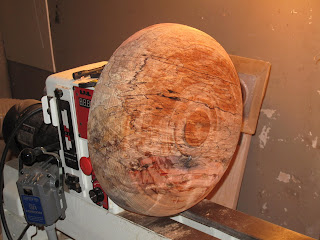
I dragged home a beautiful piece of spalted (maple?) the other day and finally got it on the lathe. It was really slow going because half of the wood is rotting and therefore less dense and lighter -- which means it'll never spin without wobbling, so you have to keep the speed way down. I didn't know just how far gone the wood was until I got into to.
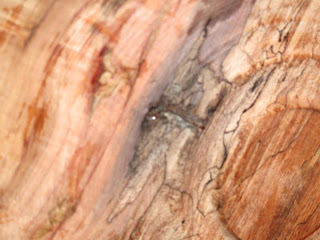
I also didn't know what else I'd find. If I was paying attention, I would have noticed the tell-tale black area emerging as I took off more and more wood: leaking iron deposits.
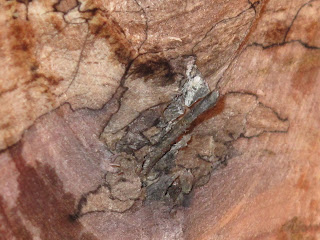
But it wasn't until I heard that familiar click, telling me I had hit a nail.
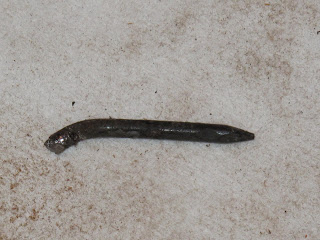
Nice.

So, you stop and drill around it; making sure not to tug too hard on it, lest you loosen the chuck's grip on the bowl. Otherwise, you gotta take more wood off to get the dang thing back in round. I got this nail out in about 15 minutes.

And no sooner had I, when -- click, click, click...

By the time I had roughed out this shallow bowl, I had a whole assortment of shrapnel.
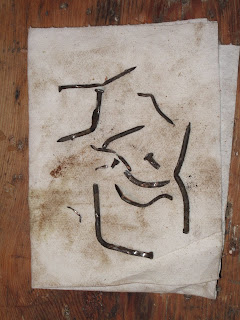
What started out as a quick half hour on the lathe turned into four and a half hours. I wrapped the emerging bowl in a plastic garbage bag between sessions so it wouldn't crack on the lathe.

When I finished roughing it out, I'd found a lot more damage to the wood than I had expected. And it's such a pretty piece, I decided to experiment on it and see if I could bring it back from the dead.

In the past, I usually soaked punky wood in a 4:1 solution of water and your basic 'white' glue. The finish is pretty dull though in the end, so I did a search online to see what others were trying.

I found a fella called The Rot Doctor not to far away. And what does he specialize in? Epoxy for damaged wooden ships. He's perfected an epoxy solution that penetrates rotting wood and within a few days, the resin sets up inside the grain making it as hard as new.

So, after this piece gets to about 20 percent water, I'll soak it for an hour. Until then, it's wrapped up in newspaper on a shelf in the basement. Waiting.